Hi readers, we are back again with episodic post design history. This week we are going to see about Etruscan art. Etruscan art is an ancient art developed in Italy.
Introduction:-
Italian art history begins with the Etruscans. Etruscan Civilization was created on the now known Tuscany region of Italy. It isn’t known where they came from, but the character of their art and many distinctive features of their religion make it clear that the original Etruscans were from a region in Asia Minor.

Period:-
During the Iron Age (1000 to 1 B.C.), urban civilization spread throughout Etruria – Tarquinia was probably the oldest city and is the most famous. The other centers were Caere (Cerveteri), Vulci, and Veii (Veio).
Concept of Etruscan Art:-
In all studies of Etruscan art, it should be remembered that a large proportion of Etruscan art did not survive up until the present day. We read of the Roman destruction of Volsinii and the destruction of 2000 Etruscan bronzes which were melted down to produce bronze coins. As a result of this, we have a somewhat skewed perception of Etruscan art, in that most of the art that survives today is funerary art, and we form totally wrong impressions about the Etruscans as a result. From excavations at Murlo, Roselle and other city sites, it is apparent that art was a normal part of Etruscan life. In Murlo, a seventh century Etruscan villa has been unearthed. Reconstructions show large painted terracotta panels adorned the entrances. Necropolis art in the form of polychrome reliefs and frescoes hint that the Etruscans used colour to great advantage even from the earliest times. Although painted tombs are among the most famous, it should be remembered that these represent a minority, and that only the aristocratic families could afford such luxuries as tomb frescoes.

The styles of Etruscan Art vary considerably between the individual Etruscan cities, and there was also significant variation on style depending on the period – so much so that we can date Etruscan art works in many cases by comparison with other examples. The interest in Etruscan Art grew during the renaissance, at which time the extant Etruscan art had considerable stylistic influences on the emerging artists of the renaissance, many of whom lived in former Etruscan cities where such art was plentiful. By the nineteenth century, Etruscan art had grown to a passion, and the “excavation” of Etruscan tombs to meet growing demands increased. An example of this is the brother of Napolean, who owned land near Canino, which included the Etruscan necropolis of Vulci. These “resources” he exploited to great effect, destroying many pieces of Etruscan art in the process, and covering in the tombs with soil afterwards. As a result of this and many other examples, we now have thousands of pieces of Etruscan Art whose provenance is unknown, and which are still in private collections , or have been donated to museums in Europe and the Unted States.
Characteristics of Etruscan Art:-
The internal walls of Etruscan tombs such as those at Cerveteri and Tarquinii still contain the remains of magnificent murals which give us a considerable insight into the Etruscan way of life. A commonly recurring theme is the banquet, which in the case of the Necropolis paintings, carried a double meaning. For the banquet was also an intrinsic part of the religious ceremony at funerals. After all the formal funeral ceremonies were complete, the relatives of the deceased were treated to a sumptuous banquet, at which the spirit of the departed was believed to attend.
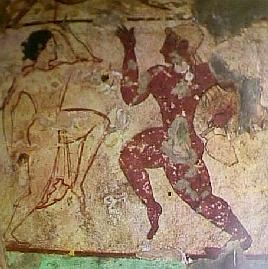
In Etruscan daily life, the banquet was very much a status symbol, indicating to all and sundry that the hosts had “arrived” in the estimation of the Etruscan social elite. Certainly in the heyday of the Etruscan league, around the seventh century BCE a wide reaching trading network (the first EEC) had been well established with far flung parts of Europe.
Techniques of Etruscan Art:-
The Etruscans at first imported and copied painted Greek pottery. They were particularly noted for their black bucchero pottery with incised or relief decoration suggesting metalwork. They were experts with the potter’s wheel. It was at its height in the late 7th and 6th centuries B.C. Working in bronze, the Etruscans made chariots, bowls, candelabra, cylindrical coffers, and especially polished mirrors, all richly engraved with mythological motifs.

The Etruscans were famous for their gold jewelry. Their gold work was among the finest anywhere in the ancient world. They also crafted silver and ivory jewelry, using filigree and granulation.
The influence of Etruscan art on the Romans was supreme from the 6th century BC until the ascendancy of Greek styles in the 3rd century B.C.
Subjects of Etruscan Art:-
- Royal Dining Scenes
- Jewelery
- Decorative art
Media of Etruscan Art:-
- Bronze
- Terracotta
- Polychrome ceramics
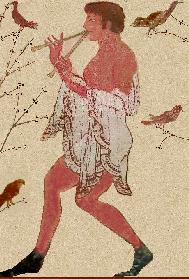
Etruscan art appears nowhere as related primary upon the influences, concepts and methods of Greek art. There are marked similarities to the art of the Phoenician cities of Tyre and Sidon, Egypt, Asia Minor, and even Assyria. It also promotes Italian elements and reflects distinctively Etruscan religious beliefs.
Etruscan art had great influence on subsequent Roman styles and was largely absorbed by the 1st century B.C.